CLICCS
Cluster of ExcellenceClimate, Climatic Change,
and Society (CLICCS)
and Society (CLICCS)
Photo: UHH/Denstorf
23 September 2026, by Denise Müller-Dum (MPI-M)
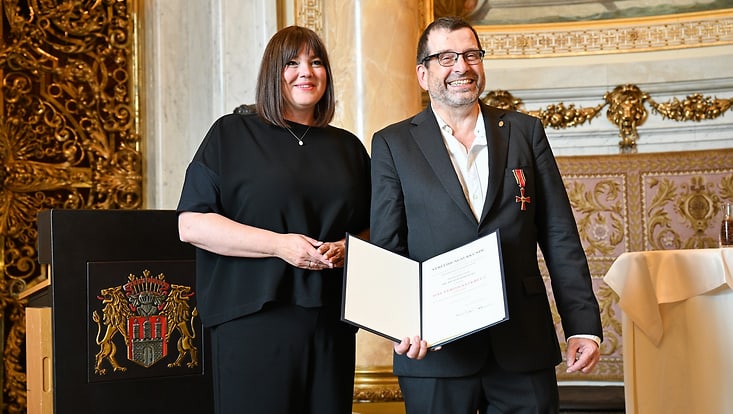
Photo: MPI-M/Ulrike Kirchner
Jochem Marotzke, director at the Max Planck Institute for Meteorology and deputy spokesperson for the University of Hamburg’s Cluster of Excellence “Climate, Climate Change, and Society” (CLICCS), has been awarded the Cross of the Order of Merit of the Federal Republic of Germany.
Federal President Frank-Walter Steinmeier recognized Jochem Marotzke’s outstanding commitment: The climate researcher’s work on the role of the oceans, the establishment of a permanent observation network to measure heat transport in the Atlantic, and the development of reliable ten-year climate predictions have had a profound impact on international climate research.
Hamburg’s Second Mayor and Senator for the Environment, Climate, Energy, and Agriculture, Katharina Fegebank, presented the award on September 23, 2026, at City Hall in the Hanseatic city.
“Jochem Marotzke is one of the world’s most distinguished climate researchers and a true asset to our city,” said the senator. “With his ocean models and ten-year predictions, he provides policymakers, the economic sector, and society with an infallible compass for sustainable decision-making. He builds the crucial bridge from foundational research to practical application and has played a key role in establishing Hamburg as a global flagship for climate science. I thank him from the bottom of my heart for this outstanding work.”
The Order of Merit of the Federal Republic of Germany is awarded by the Federal President for outstanding service and presented on his behalf by the state governments. The order is awarded for political, economic, social, and intellectual achievements.
“I am deeply honored and would like to express my sincere gratitude for this award. It underscores the importance of research into our climate and human-induced climate change —and the dialogue about these topics—for our community,” said Marotzke. “As scientists in Germany, we enjoy comprehensive freedom of research, allowing us to tackle the most exciting, challenging, and relevant questions in this field. I consider this a great privilege—and an incentive to continually expand our body of knowledge and continue the conversation about our findings.”
Jochem Marotzke studied physics in Bonn, Copenhagen, and Kiel and earned his Ph.D. in physical oceanography from the University of Kiel. From 1990 to 1999, he conducted research at the Massachusetts Institute of Technology (United States); he then served as a professor of physical oceanography at the Southampton Oceanography Centre (United Kingdom). There, together with colleagues, he established the RAPID Array, a program for the continuous measurement of the Atlantic overturning circulation. In 2003, he was appointed director at the Max Planck Institute for Meteorology, where he advanced the development of modern Earth system models. In 2006, he also assumed a professorship at the University of Hamburg.
He contributed to the Intergovernmental Panel on Climate Change (IPCC) as the coordinating lead author of two assessment reports. To bridge the gap between short-term and seasonal forecasts and long-term climate projections in Germany, he also initiated the establishment of a national program for decadal climate predictions, which have been carried out by the German meteorological service (Deutscher Wetterdienst, DWD) since 2020. As deputy spokesperson for the University of Hamburg’s Cluster of Excellence “Climate, Climate Change, and Society” (CLICCS), he is also dedicated to researching the social dimension of climate change and has been a key driver of interdisciplinary climate research in Hamburg for many years.
In addition to his research, Marotzke has held key honorary positions, including as chairman of the board of the German Climate Consortium, on the Scientific Advisory Board of the DWD, on the Advisory Board of the GEOMAR Helmholtz Center for Ocean Research Kiel, and on the Joint Scientific Committee of the World Climate Research Program. He is a member of, among others, the National Academy of Sciences Leopoldina and the German Academy of Science and Engineering (acatech), and is a prominent voice in the public debate surrounding climate change and its consequences.
This text is based on a press release from the Ministry of Environment, Climate, Energy, and Agriculture of the Free and Hanseatic City of Hamburg.