CLICCS
Cluster of ExcellenceClimate, Climatic Change,
and Society (CLICCS)
and Society (CLICCS)
Photo: UHH/Denstorf
10 July 2026, by Michael Schnegg, Julian Sommerschuh
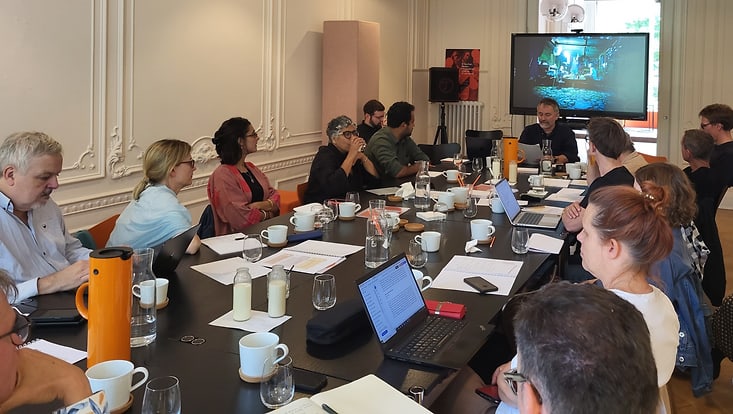
Photo: Tiana Rogge
What role can hope play in addressing climate change and the ecological crisis? Under the title ‘Climate Hope’, international anthropologists and philosophers discussed this topic from 2 to 4 July 2026 at the fourth ‘Hamburg Symposium on Philosophy and Anthropology’. Michael Schnegg and Julian Sommerschuh from sub-project S1 organised a workshop in collaboration with the Hamburg Institute for Advanced Study (HIAS).
The starting point was the observation that debates on climate change are strongly shaped by fear, despair, and a sense of powerlessness. These emotions can motivate action, but they are also associated with psychological strain, social exhaustion, and political paralysis. The workshop therefore asked under what conditions climate hope emerges, which forms of hope are helpful or problematic, and what effects hope has on individual and collective action.
It became clear that hope cannot simply be understood as a positive counter-emotion to fear. There was broad agreement that some hopes need to be relinquished: the hope for a complete “solution” to the climate problem, for a return to untouched pre-industrial conditions, or for full human control over the ecological future.
At the same time, there was agreement that the existence of problematic hopes should not lead us to abandon hope as such. Rather, what is needed are concrete hopes for desirable futures: for greater justice, for the preservation of conditions that allow human and nature to live and flourish, and for forms of coexistence that can endure even under uncertain conditions. In addition, the workshop highlighted a less goal-oriented dimension of hope: an attitude of bearing, persistence, wayfinding, (re)orientation, and perception that enables people to remain capable of action even where clear solutions are lacking.
The exchange between philosophical and ethnographic perspectives proved particularly productive. Philosophical contributions clarified different concepts of hope and raised normative questions about good and bad forms of hope. Anthropological contributions showed how differently people in various regions of the world respond to the climate crisis. In doing so, they made clear that hope often does not arise from abstract optimism, but from concrete relationships: with other people, local communities, land, plants, and animals.
The workshop showed that climate hope is neither an illusion nor a mere mood. It can be understood as a practical capacity to remain oriented, attentive, and capable of action in a damaged and uncertain world. The discussions from the symposium will be continued in a planned edited volume.
Further information:
Hamburg Symposium on Philosophy and Anthropology
Climate Hope