Surface Breakers Gathering
Surface Breakers Gathering
21 January 2026, by Charlotte Bohne, Jordis Hansen, and Kaja Scheliga
The “Breaking the Surface: Women in Marine Research” presents eleven portraits of researchers from northern Germany who are shaping oceanography with their work. The exhibition was displayed from July 2025 to January 2026 at the International Maritime Museum Hamburg. The portraits and in-depth interviews with the scientists can also be found online: www.breaking-the-surface.com
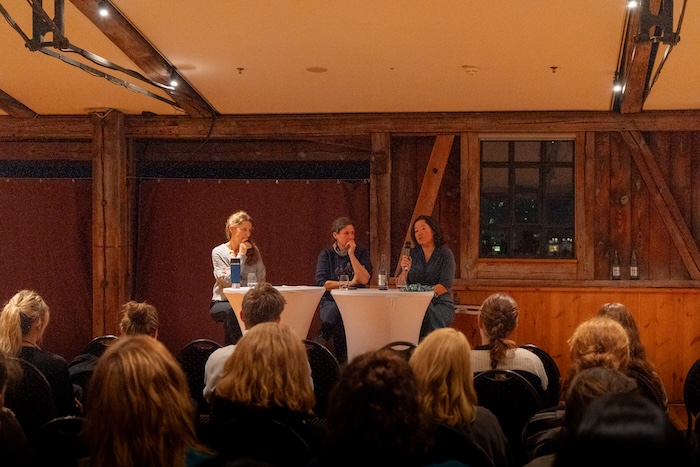
The Breaking the Surface gathering at the International Maritime Museum Hamburg gave around 60 students and early career researchers the opportunity to engage in an open discussion with three female professors in physical oceanography at the University of Hamburg – Stefanie Arndt, Eleanor Frajka-Williams, and Johanna Baehr – who are also featured in the Breaking the Surface: Women in Marine Research exhibition.
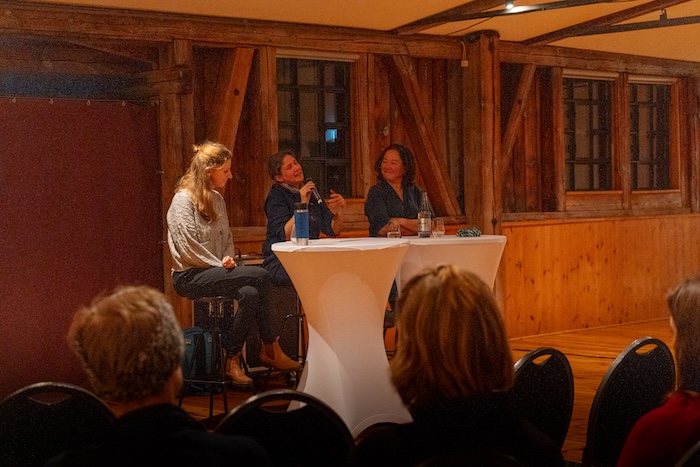
All three primarily see themselves as oceanographers rather than female oceanographers. Nevertheless, one of the factors that motived them to be part of the exhibition is to join efforts in making female oceanographers and their achievements more visible. By engaging in outreach activities and sharing realities of their academic career journeys, they serve as role models who are approachable for others considering similar paths.Johanna Baehr became the first female professor in oceanography at the University of Hamburg in 2009. For a few years, she was the only one – the only female professor, the only female professor with children. In 2015 she was joined by Corinna Schrum, followed by Eleanor Frajka-Williams in 2022 and Stefanie Arndt in 2024. Their stories show, how the historically male dominated field of oceanography is (slowly) changing.
As audience members, we heard about what it is like being the first and only female professor at an institution. It was particularly striking how much your work as a woman is implicitly devalued, how much additional (often invisible) work is expected through representation on committees, and the sheer number of open and hidden micro-aggressions encountered.
Another part of interest from the audience was their scientific work, particularly about what happens in the large-scale circulation in the Atlantic. This started a brief discussion about which research gets funded, since changes in the Atlantic primarily affect Northern America and Europe. Most of the audience questions, however, centred around personal experiences of working as a woman in a historically male-dominated field, as this gathering opened up the opportunity to discuss topics that are usually not discussed in a scientific setting.
By now, most oceanography institutes in Germany have at least one leading female scientist. However, the University of Hamburg remains the only institution with more than one female professor in physical oceanography. Listening to the speakers really drove home the point that there is a massive difference between being the only woman at an institute and being one of several.
As a female early-career scientist, it is encouraging to work in an environment where female professors support one another and actively advocate for younger scientists, regardless of hierarchy.
The evening ended with snacks and drinks, offering participants the opportunity to have one more look at the Breaking the Surface exhibition and to talk some more with the professors, fellow students, and other early career researchers. We left with a better understanding of the challenges faced by female professors in a historically male-dominated field of science in Germany and began building our own support networks.